
Pleasant Lake Bog
A new addition to Orchard Road Bog expands protection to nearly 146 acres of rare habitat!

A sense of adventure held us under its spell, so we hardly noticed the tropical humidity, scratchy plants, or blood. After all, we were exploring a bog and this was just the price of admission!
We made it through the perimeter without losing our boots in the mud, but the second test was harder: navigating the dense maze of “Poor Conifer Swamp,” an amazing habitat that’s not designed for humans. Thin, gnarly pine branches threatened to poke our eyes. Thick bushes blocked the view more than a few feet ahead. Logs hidden by sphagnum moss tried to throw us off balance into the waiting arms of poison sumac trees. We followed Kaleigh, SWMLC Land Protection Director, who successfully led us through using a tracking app on her phone.


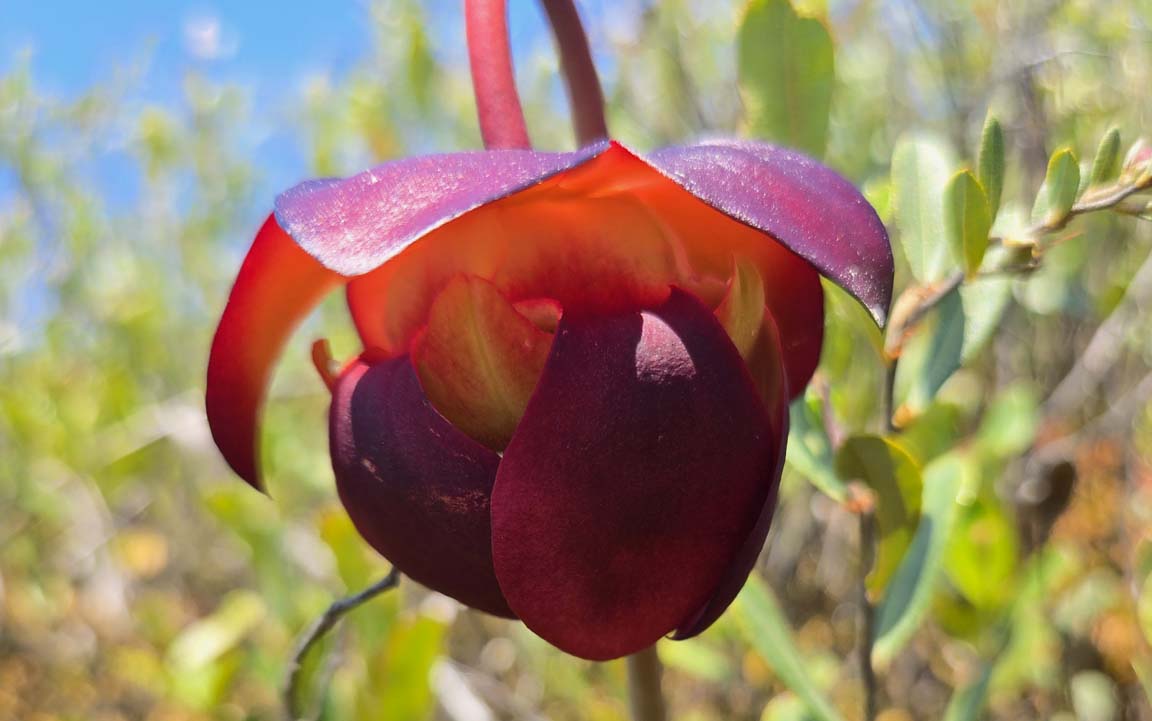
When we broke free into the bog, we stopped for a moment to savor the view. Blue Pleasant Lake sparkled in the distance beyond a wide stretch of thigh-high leatherleaf shrubs. Tiny sundews and the strange nodding flowers of pitcher plants were tucked between mounds of brightly colored sphagnum moss. It was an enchanting place and we hoped SWMLC would be able to protect it.



And the following year – this year (2026) – we did!
Soon after that 2025 field trip described above, SWMLC protected nearby Orchard Road Bog. Now, with funding coming from a North American Wetlands Conservation Act (NAWCA) grant, we’ve added Pleasant Lake Bog: two parcels that include 63 acres of old growth oak-hickory forest and sensitive wetlands. The larger parcel shares a border with Orchard Road Bog, creating nearly 146 acres of protected bog and poor conifer swamp, natural communities that are rare in southwest Michigan.

When combined with neighboring Barry County wetlands, Orchard Road and Pleasant Lake Bogs are part of the largest Bog/Poor Conifer Swamp complex in southern Michigan, measuring close to 600 acres! Pleasant Lake Bog is in the Spring Brook subwatershed and SWMLC’s Nature’s Network ‘Augusta Creek Corridor’ and ‘Barry Biodiversity Hub.’ Both bog properties were included as priority sites in Four Townships Water Resource Council’s Gull and Augusta Creeks Watershed Management Plan. Pleasant Lake Bog also protects 1,345 feet of frontage on 148-acre Pleasant Lake, where multiple nesting pairs of State Threatened common loons have been confirmed.

Pleasant Lake Bog is exceptionally pure, with virtually no invasive species present! Some of the unique plants that have been found include carnivorous pitcher plants and sundews, pink lady slippers, Dragon’s mouth orchids, tawny cotton grass, Virginia chain ferns, and tamaracks. State Threatened Blanchard’s cricket frogs have been found on the property.

Bogs are highly sensitive to changing water levels and are not only threatened by nearby development, but can also be degraded by peat harvests, invasive shrubs like buckthorn, and offroad vehicles. In addition, they’re an important part of the landscape, filtering water and storing more carbon than forests. Many bogs were formed when the glaciers melted some 15,000 years ago, so they’ve been crucial to the way things work for a very long time.
To consider that Pleasant Lake and Orchard Road Bogs may have existed nearly unchanged for so long is mind-bending!
To consider that Pleasant Lake and Orchard Road Bogs may have existed nearly unchanged for so long is mind-bending!


At SWMLC, we’re both proud and humble to be the ones to protect places like this, but we couldn’t do it without the financial support of our community. The privilege and responsibility are shared by us all and we’re so grateful that you walk this conservation path with us. Thank you.
